A tube mill is a continuous production system that forms flat steel strip into round, square, rectangular or application-specific closed sections. Forming, welding, sizing, cutoff and handling must work as one coordinated line.
Five connected stages
Coil preparation
Steel strip is uncoiled, levelled and prepared for continuous feeding. Production planning starts with material grade, coil dimensions and strip condition.
Forming
Successive roll stands progressively bend the strip toward the required round or shaped section while controlling edge position and material flow.
Welding & scarfing
The formed edges are joined—commonly with a high-frequency process for ERW tube—before external or internal bead treatment where required.
Cooling & sizing
The welded tube is cooled, guided and passed through sizing stands to control final geometry, straightness and dimensional repeatability.
Cutoff & handling
A coordinated cutoff system produces the required length before inspection, transfer, bundling or downstream processing.
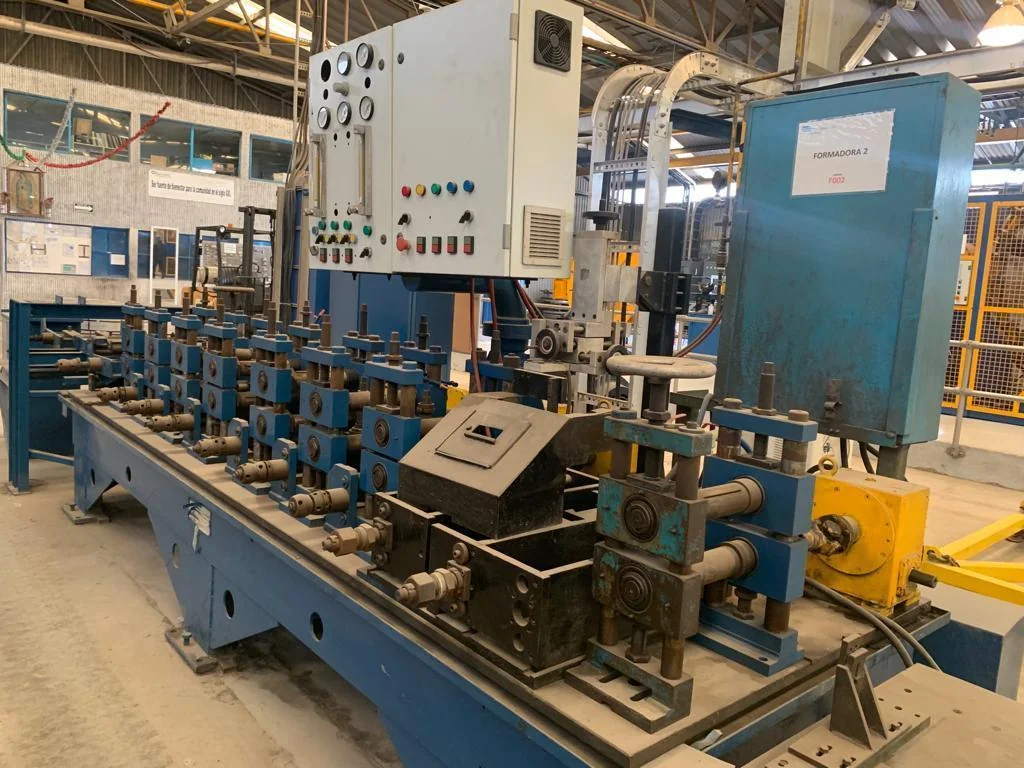
A line is only as reliable as its interfaces.
Typical projects can involve an uncoiler, strip preparation, accumulator, forming and sizing stands, welding equipment, cooling, straightening, cutoff and handling. Gearboxes transmit power to the stands; hydraulic cylinders position or clamp equipment; roller guides control material; automation coordinates speed, sequence, interlocks and diagnostics.
What to prepare before requesting a proposal
- Finished tube or section range
- Wall-thickness range and material grades
- Target line speed and annual or shift output
- Welding process and weld-quality requirements
- Cut lengths and downstream handling
- Available plant layout, utilities and integration points
- Required automation, operator and reporting functions
Where formed tube is used
Tube and roll-formed sections serve construction and infrastructure, automotive components, furniture, appliances, material handling and general fabrication. The final application influences material, tolerance, surface condition, weld requirements and production flexibility.
Planning a new line or modernization?
NSG EA can review the product range, existing equipment and priority performance constraints.
Discuss the project